WHEN?
Three days, one spec spot, two clients and one idea: every film we make should make the next one better. Plus what Ben Affleck’s $587 million AI company has to do with it.
Everybody wants to know when Anthropic goes public. Nobody knows.
WHEN? is a 30-second spec spot we made for Client 2, an ETF issuer we’ll call ETF X (NDA). It plays from your point of view, and you are desperate to know. You type “when will anthropic” into a search bar and the dropdown runs through the big questions: cure cancer, replace my job, get us to Mars, become sentient. You keep typing right past all of them. “Go public.”
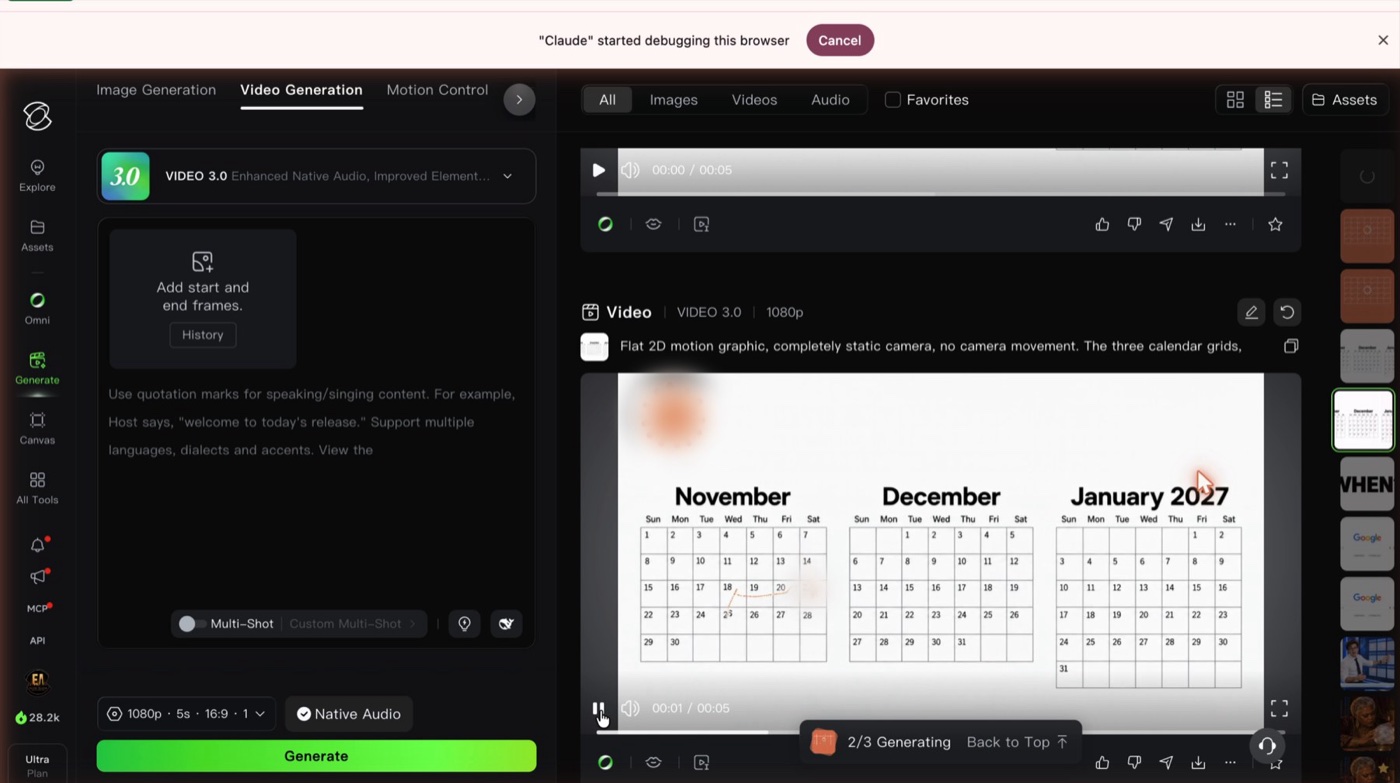
So you turn to the usual sources. A caffeinated cable news analyst circling every date on the wall and never landing on one. A fortune teller squinting into a cloudy crystal ball. A Magic 8-Ball: Reply Hazy, Try Again. You even ask Claude, and the spinner just keeps turning over a blank calendar.
That’s the joke, and it’s the point. Everyone is just as desperate to know how to play the IPO. Nobody can tell you when. That’s where ETF X comes in: whenever it happens, they’ll make sure you’re ready. That’s the tag.
The idea
I spent twenty years in television as an executive, a writer, and a producer. Here’s what I know about studios.
A studio isn’t a soundstage. It isn’t the commissary, or the writers’ building, or the animators’ building, or the actors under contract. A studio is the means of fusing all of those elements into cinematic stories: movies, TV, and these days, videos.
Every old Hollywood studio had the same cameras. They used the same wood and paint for their sets and matte paintings. They hired from the same pool of actors. What made them different was their creative mandates, their production processes, and the people who knew how to use those elements. MGM made the best dramas. Warner Bros. made the best crime pictures. Universal made the monster movies. The people, the playbook, the house style, every decision that worked, sitting there ready to use again. That’s how the old studios could turn out a picture a week.
The difference now is AI. Built into a studio’s own process, it gives any company or individual that same storytelling power. So that’s what CanEl does. Every client gets its own studio. Their cast, their look, their rules, their record of what worked. Film one builds it. Film two starts from it.
And our process gets better with every job. Not the creative, not anyone’s story or characters. The process: how our team actually makes the film. Client 1’s story stays Client 1’s. What we learned making it comes with us.
That’s the claim. Here’s the proof.
How WHEN? got made
The paper came first. Before a single image: a research dossier on five issuers, a plain-language primer on what a leveraged ETF actually is, five concepts and an ideation review.
The pivot. One concept, The Walk, went four treatments deep. Then Sean and I made a call. The story we were telling with The Walk belongs further along in a series. The real drama right now is that nobody knows when Anthropic will go public, and everyone is speculating about it every day: in the trades, in the Journal, on every blog. So we changed course. That was a human call, strategic and creative. The AI just responded.
On a traditional production, that pivot almost never happens. Once you’re down the road with a client, materials made, cast and crew being hired, you are not turning around. With AI, the pivot was simple. And nothing from The Walk was wasted. Everything we learned and built for it went into this.
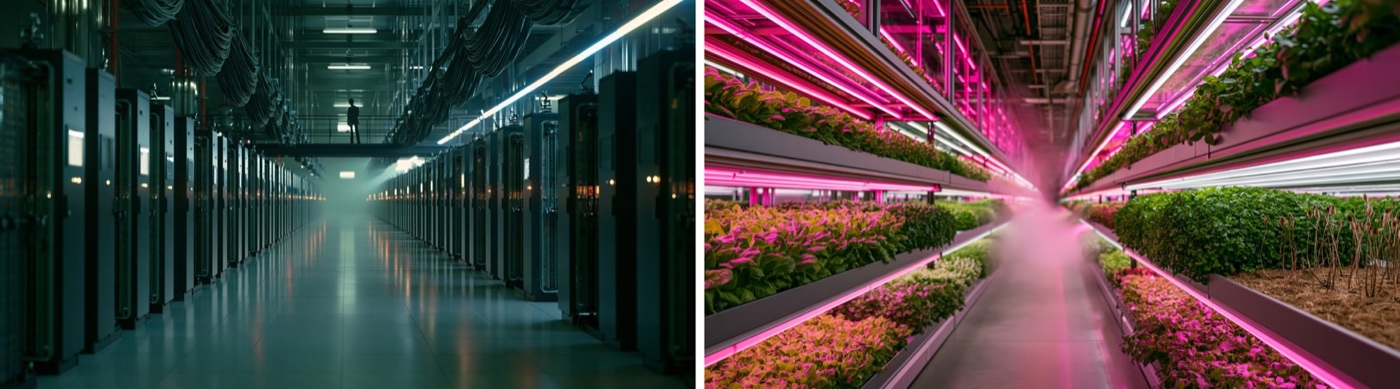
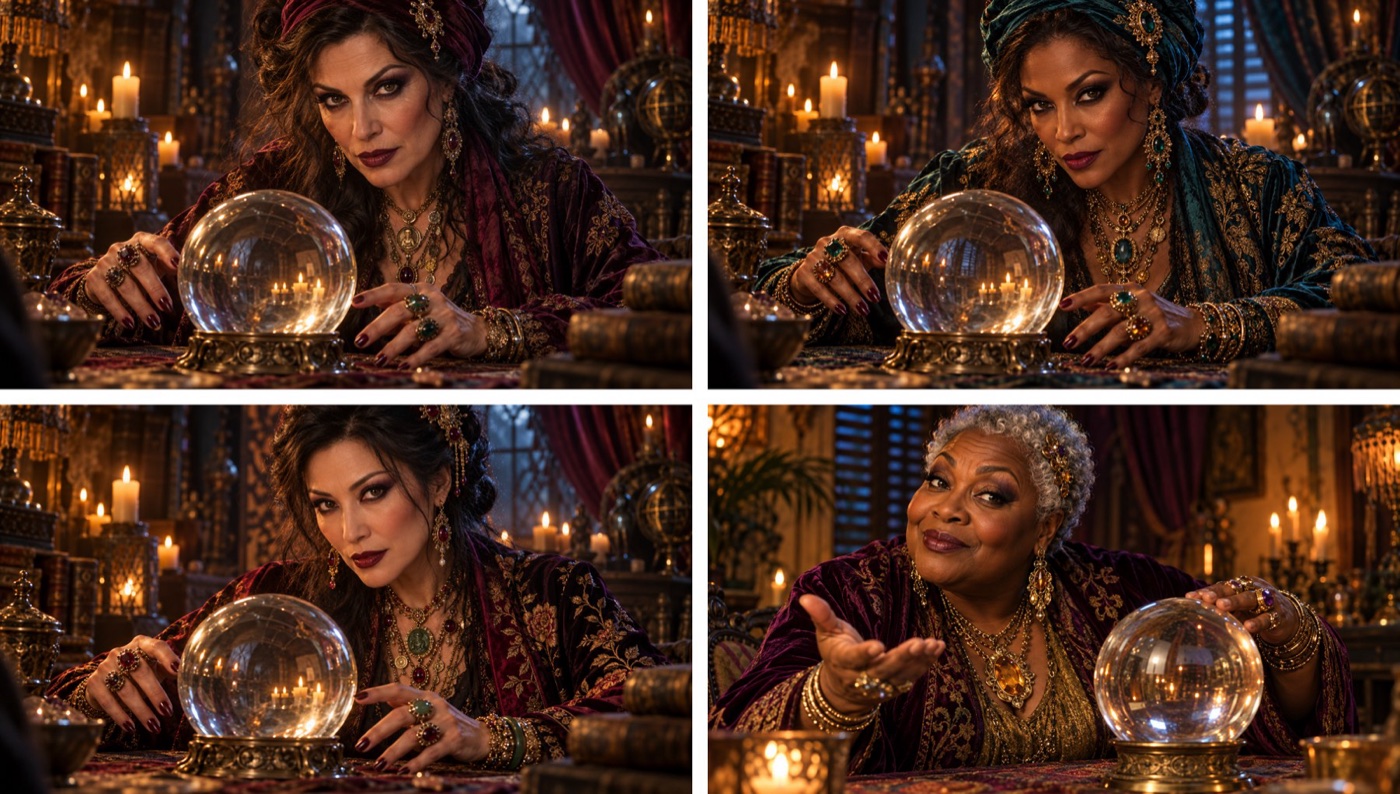
Casting was a sheet of faces, not a week of sessions. Three analysts. Three fortune tellers, then four more passes on her alone until she was right.
The script did the legal work. By version 3.1, one note was underlined: the analyst never lands on a date. If he points at one, even as a joke, the spot has made a prediction, and an issuer can’t make a prediction. Compliance written into the blocking. No model makes that call for you.
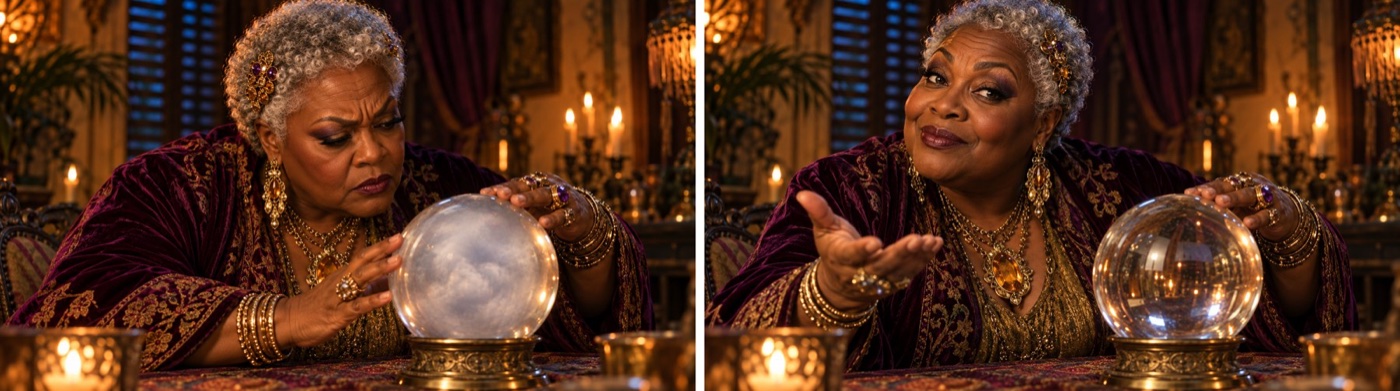
The happy accident. The fortune teller’s end frame came back with a grin and an open-palm shrug instead of the flat, tired look in the brief. Better beat. We kept it. It also broke continuity: cloudy ball in the first frame, clear glass in the second, different earrings. Same problems you get on a set, except we caught them on a still, not on day three.
The Oracle got cut. We cast and built a scene with the Oracle at Delphi, the priestess the ancient Greeks traveled to for prophecy. Then we cut it, because the spot played better with one less non-answer. On a set, losing a scene you’ve already built is a budget meeting. Here it was a decision.
The clock. From idea to finished cut, this video took us three days. Every video is different, and the timeline depends on what the story needs. This one took three days.
Where the process came from: Client 1
Before WHEN?, Sean and I made a film for Client 1, a financial firm. When it was done, we wrote everything down. Every image and video prompt that worked, why it worked, and what to watch for next time. The ones that failed got thrown out.
Here’s what that taught us, and where it showed up in WHEN?
- Fix the still, not the take. Client 1 taught us never to ask the video model to fix a wrong face. Fix the frame first. On WHEN?, every character was locked on a still before a second of motion was rendered. We fixed images, not takes. Anything that needed correcting in the generated video got fixed in post, the way it would on any movie or series. Old process, new tech.
- Name the light, not the mood. Words like “golden hour” pushed a color cast through Client 1’s footage. So on WHEN? we prompted the way a DP talks: lighting, lenses, camera. The fortune teller’s parlor is lit by a fringed lamp on the table and a neon palm in the window.
- Know when to use one frame and when to use two. Client 1 taught us when the video model needs a start and an end frame, when one is safer, and that it can’t invent a character who isn’t already in the shot. WHEN? was planned around that from page one.
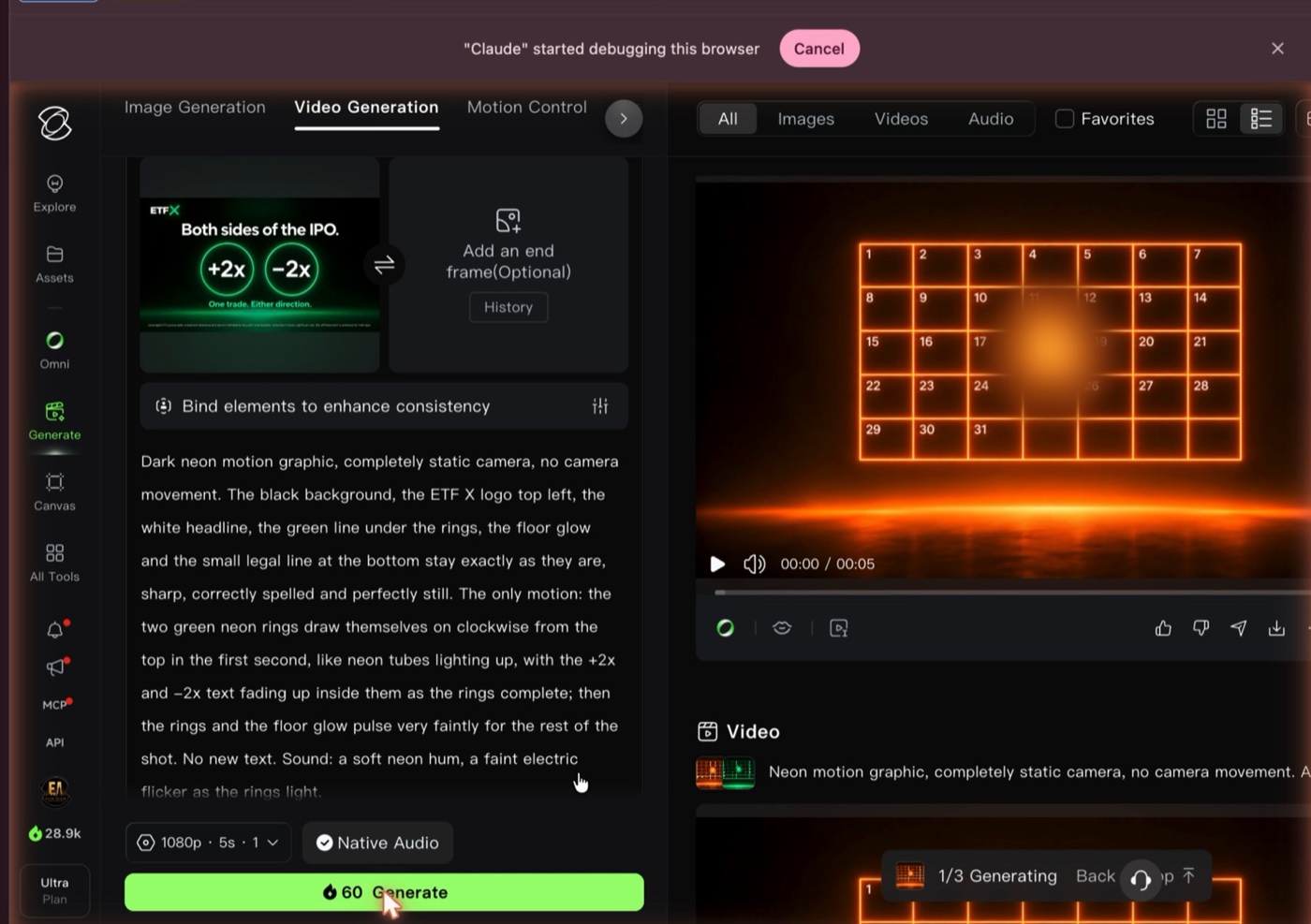
It compounds inside a client, too. Even the concept we didn’t make paid for itself. While we were developing The Walk, we gave a note: the more specific we get about motion, the more hit-and-miss the generation gets. That note became a written rule. By WHEN?, every motion direction was one sentence.
Frankly, that’s the best way to give notes to an actor as a director or a showrunner. Don’t overcomplicate it. Let the professional take your meaning and offer a creative interpretation back. It’s the same with the AI.
Here’s what’s in Client 2’s studio now that WHEN? is done: a cast. A locked look. A set of rules about what a financial spot can and can’t say on screen. The next film for Client 2 doesn’t start at zero. It starts at version 11.
Now the Affleck part
Ben Affleck sat down recently to talk about InterPositive, the AI company he founded and sold to Netflix. Variety and Deadline reported the price at $587 million. Two things he said stuck with me.
First, when he went to see the AI labs, he realized the people building these models are world-class mathematicians who don’t know film grammar: lenses, light, composition, how a production actually runs. So he didn’t build a model. He took open models that already understood shapes and physics and trained a layer on top that understands cinema. The last mile.
That’s CanEl. We don’t build the video models. Anybody can rent those. What we build is the layer on top: the script logic, the casting, the light and lens choices, the list of things the model always gets wrong, the call on whether the analyst lands on a date.
Second, on InterPositive every production trains its own model on its own footage. It learns that film and only that film, and the work stays with the project.
His version is a model per production. Ours is a studio per client, and a process that gets sharper with every job. Same principle: the decisions are the asset, and they compound.
Same math, different size
Affleck is doing this for Netflix features. We’re doing it for 30-second spots. When the decisions compound, a few things about how films get made stop working the old way.
- Risk. You see the film as stills before anyone pays for motion. A bad idea dies on a still, not in a reshoot.
- Time. Three days on this one, from idea to finished cut.
- Return. The second film costs less than the first. The fifth costs less than the second, and it’s better.
- Decisions. A note becomes a revision. The person who gave it sees the change the same day.
- What gets made at all. A cable news set, a fortune teller’s parlor and the Oracle at Delphi, in one spec spot. Nobody budgets three locations for a spec. Take the constraint off and the idea gets to be the idea.
One last thing
Affleck says nobody’s going to pay to watch a movie made from a text prompt. Agreed. There’s no prompt-to-movie in WHEN? There’s a dossier, a primer, five concepts, a script on version 3.1, casting sheets, a shot list, two rounds of image review, eleven cuts and everything we learned on Client 1. The machines did the rendering. People made the movie.
Every client gets a studio. Client 2’s is up and running. Send a brief and we’ll start yours.