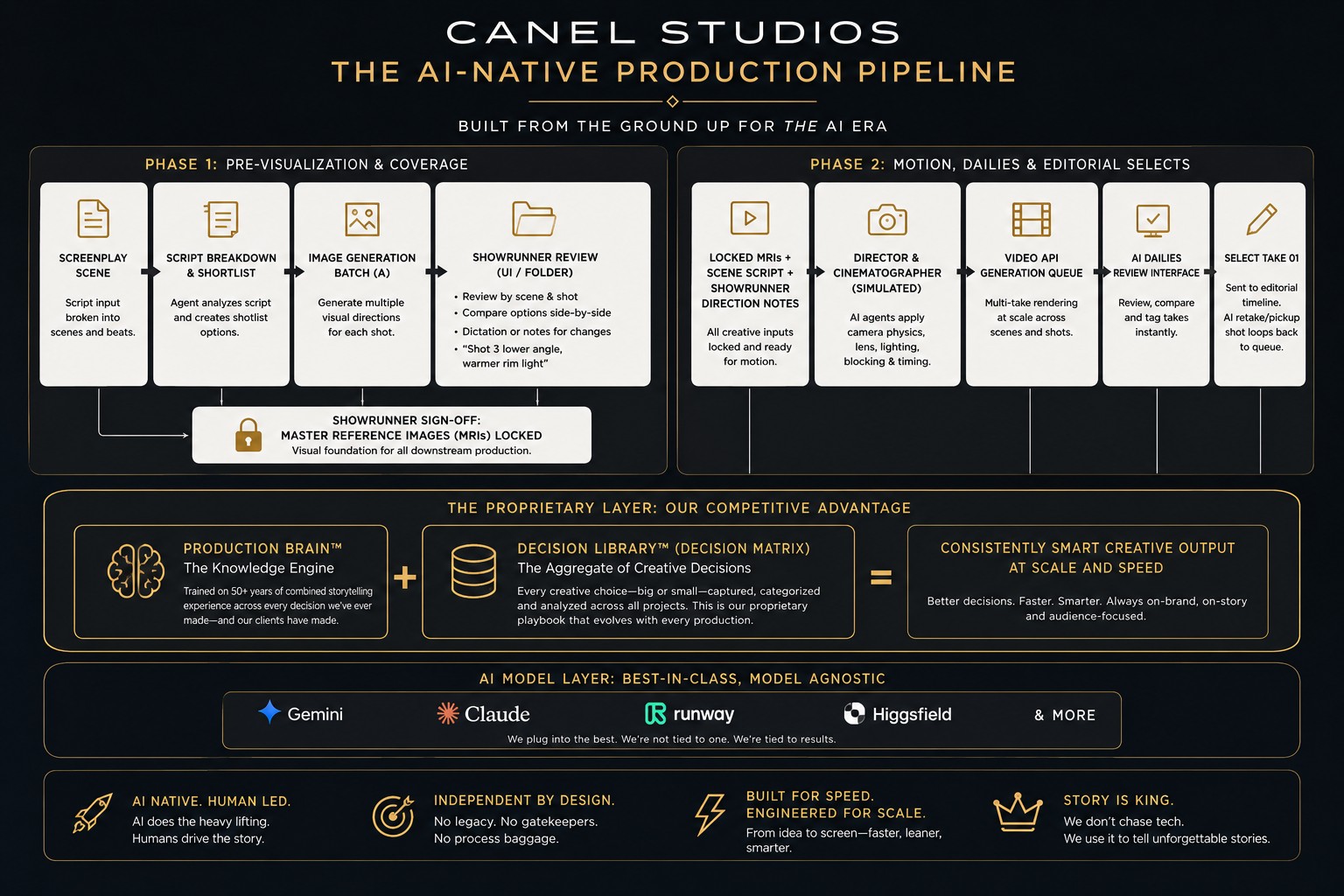
Anyone can prompt a model and get something back. The difference is what governs the asking — and what happens to the answer. This is the whole process, start to finish, including the part that protects your budget.
Everything in this phase is still images. Quick to produce, quick to change, and the place where every creative argument gets settled before it becomes expensive.
Your script, brief, or campaign message is broken into scenes, beats, locations, and the emotional turn each moment has to land.
Coverage is planned the way it would be on a set — masters, two-shots, overs, inserts, close-ups — before a single frame is generated.
Several visual directions are rendered in parallel for each shot, so the choice is made by comparison rather than by accepting the first result.
We review the contact sheet together. Notes go back in as notes — “lower angle, warmer light on his face” — and targeted re-renders come back.
This is the discipline the whole process rests on. The still frames are reviewed, revised, and signed off before any motion is rendered. No video gets made, and no budget spent, on a look that has not been approved.
It is also why the finished piece holds together. Every shot that follows inherits the same locked references, so the character, the location, and the light stay consistent across the whole film rather than drifting shot to shot.
Now the approved frames become film. Because the look is already settled, this phase is execution rather than exploration.
The approved frames, the scene, and the direction notes become the brief the motion pass works from.
Camera move, focal length, lighting and the timing of the blocking turn a still frame into a shot.
Every shot is rendered several times, the way it would be covered on a set. The best take gets chosen, not the first one.
Takes are reviewed and tagged the way dailies always were, with everyone looking at the same cut.
Selects go to the edit. Anything that needs changing goes back through in minutes, not a reshoot.
The generators are available to anyone. What is not available to anyone is what decides what to ask them for, and what to do with what comes back.
Screenplay structure, pacing, lens choice, and the producing instinct for what an audience will actually sit through. Decades of it, from people who did this before the tools existed.
Every choice we make — the output taken, the ones rejected, and why — kept and carried forward. Including yours, so your next film starts knowing what you liked.
Not just faster. Better informed — about what your audience responds to, what your company sounds like, and which arguments have already landed.
The generators we use — and there are several — are rented equipment. Lights, lenses, a stage. When a better one ships, we switch to it, and nothing about how we work changes: the same references, the same records, the same judgment.
A director shooting on a studio lot uses the lot’s cameras and stages. The script, the eye, and the cut are still his. That is the right way to think about where the value sits here.
It also means you are not exposed if one company raises its prices, changes its terms, or simply gets overtaken.
| Traditional production | Someone using AI tools | CanEl | |
|---|---|---|---|
| How it runs | Crew, location, schedule. Expensive to start, expensive to change. | Prompting by hand in a chat window, one image at a time. | A pipeline, run to a plan, with a person accountable at every gate. |
| What survives it | Footage, and whatever stayed in people’s heads. | Very little. Chat logs, mostly lost. | Locked references and a record of every decision, kept and reused. |
| Changing something | A reshoot. Days and real money. | Regenerate and hope. The look tends to drift. | A pickup through the same locked references. Minutes. |
| If the tools change | Not applicable, but the cost base never falls. | Stuck with whatever that one platform does next. | We swap the model. Nothing else changes. |
Whether it is one film or a run of them, the process above is the same. Tell us what you are trying to say and we will tell you what it would take.